
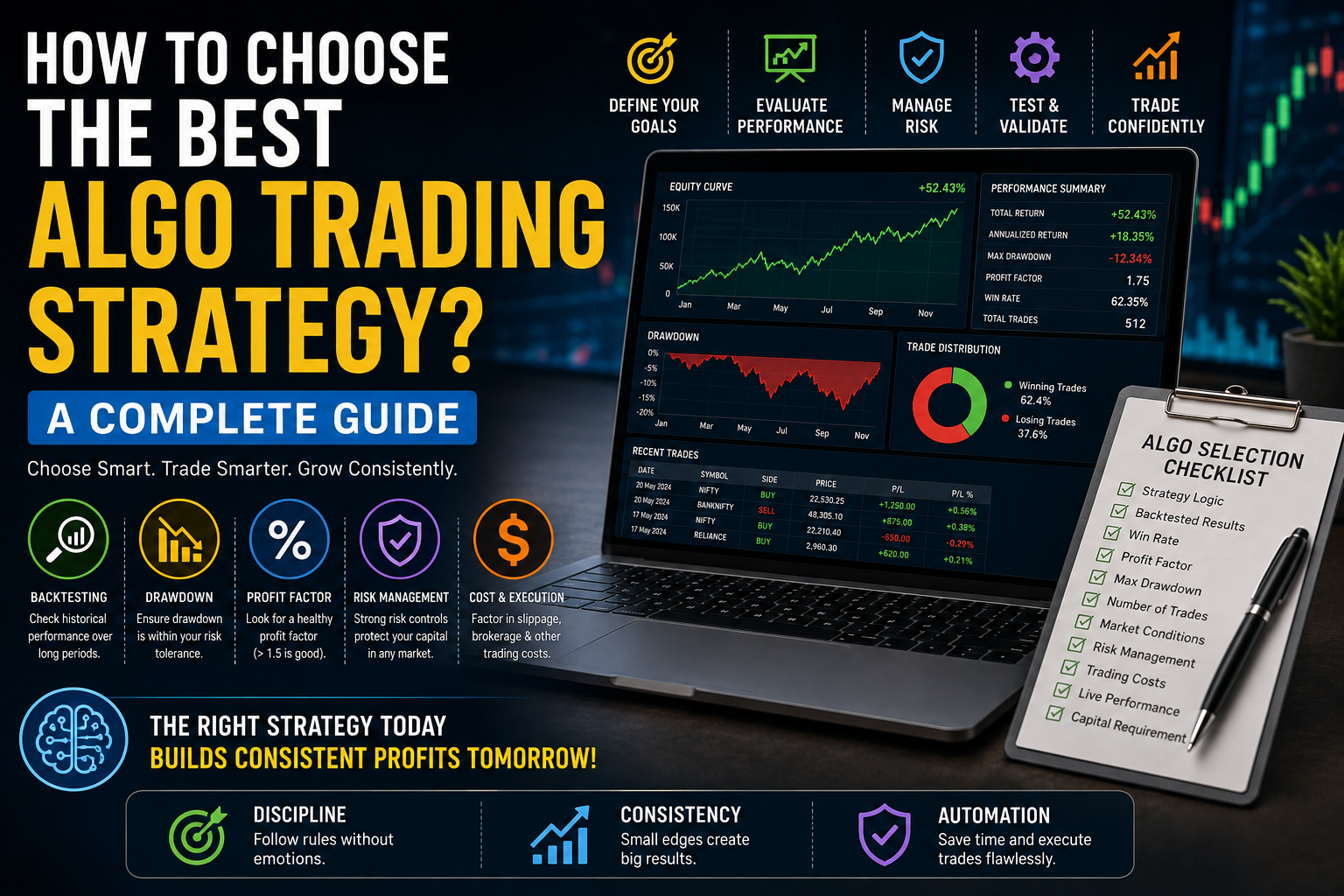
Algorithmic trading has become increasingly popular among traders who want to automate market analysis, trade execution, and risk management. However, with so many trading strategies and algo systems available, one important question remains:
How do you choose the best algo trading strategy?
The answer is not simply to choose the algorithm with the highest historical return or the highest win rate.
A good algo should be evaluated based on risk, consistency, drawdown, testing methodology, execution costs, market conditions, and your own trading objectives.
In this guide, we explain how to evaluate and choose an algorithmic trading strategy more effectively.
What Is an Algo Trading Strategy?
An algo trading strategy is a predefined set of rules that a computer system uses to identify trading opportunities and execute trades.
Depending on the strategy, an algorithm may use:
- Price movements
- Technical indicators
- Market trends
- Trading volume
- Volatility
- Statistical relationships
- Time-based conditions
- Fundamental data
Different algorithms are designed for different markets, timeframes, and risk profiles.
There is therefore no single best algo for every trader.
What Makes an Algo Trading Strategy Good?
A strong algo trading strategy should not be judged by one metric.
Instead, look for a combination of:
- Consistent performance
- Controlled drawdown
- Robust backtesting
- Realistic transaction-cost assumptions
- Adequate trade history
- Good risk management
- Performance across different market conditions
- Reasonable execution requirements
The objective should be to find an algo that fits your trading requirements rather than simply choosing the one with the biggest historical return.
1. Define Your Trading Objective
Before choosing an algo, determine what you want the system to achieve.
Ask yourself:
- Am I looking for intraday or swing trading?
- Which market do I want to trade?
- How much capital am I allocating?
- How much drawdown can I tolerate?
- How frequently do I want to trade?
- Do I want fully automated execution?
- What is my investment horizon?
For example, an intraday strategy and a long-term trend-following strategy can have completely different risk and performance characteristics.
2. Understand the Strategy
Never choose an algo simply because its performance numbers look attractive.
You should understand the basic logic behind the strategy.
Ask:
What market behavior is the strategy trying to capture?
For example, an algo may be designed for:
- Trend following
- Momentum
- Mean reversion
- Breakouts
- Statistical arbitrage
- Volatility-based trading
Understanding the underlying approach makes it easier to determine whether the strategy is suitable for your objectives.
3. Check Backtesting Results
Backtesting is one of the most important steps when evaluating an algo.
A backtest applies the strategy to historical market data to estimate how it would have performed under past conditions.
Look beyond the headline return.
Check:
- Testing period
- Number of trades
- Maximum drawdown
- Profit factor
- Win rate
- Average trade
- Transaction costs
- Market conditions included
A strategy showing high returns over a very short period may require much more investigation.
For more information, read our guide on What Is Backtesting in Algorithmic Trading?.
4. Don't Focus Only on Win Rate
A common mistake is choosing an algo because it has a very high win rate.
For example, consider two strategies:
Strategy A
- Win rate: 80%
- Average winning trade: ₹500
- Average losing trade: ₹2,500
Strategy B
- Win rate: 50%
- Average winning trade: ₹2,000
- Average losing trade: ₹1,000
Strategy B could potentially have a better overall risk-reward profile despite having a lower win rate.
This is why win rate should always be evaluated alongside other metrics.
5. Check Maximum Drawdown
Maximum drawdown measures the largest decline from a previous peak in the strategy's equity curve.
Suppose an account grows from ₹10 lakh to ₹14 lakh and later falls to ₹11 lakh.
The drawdown from the ₹14 lakh peak is approximately 21.4%.
Drawdown is important because two strategies with similar returns can have dramatically different levels of risk.
Before selecting an algo, ask:
Can I realistically tolerate the historical drawdown of this strategy?
If the answer is no, the strategy may not be appropriate for you.
6. Examine Profit Factor
Profit factor compares gross profits with gross losses.
Profit Factor = Gross Profit ÷ Gross Loss
For example, if a strategy generated ₹5 lakh in gross profits and ₹3 lakh in gross losses:
Profit Factor = 1.67
A higher profit factor can be a positive indicator, but it should not be considered in isolation.
The number of trades, testing period, drawdown, and transaction costs also matter.
7. Look at the Number of Trades
A strategy's performance should be supported by an appropriate number of trades.
Suppose an algo claims exceptional returns based on only 15 historical trades.
That may not provide enough evidence to judge its robustness.
A larger sample can provide more information, although the appropriate number depends on the strategy and timeframe.
8. Check Performance Across Different Market Conditions
Markets do not behave the same way all the time.
They can experience:
- Strong bull markets
- Bear markets
- Sideways markets
- High volatility
- Low volatility
- Sudden market shocks
A strategy that works only in one specific market environment may struggle when conditions change.
When evaluating an algo, examine its historical behavior across different market regimes where sufficient data is available.
9. Understand Backtesting vs Live Performance
One of the most important questions is:
Does the live performance resemble the backtest?
Backtesting is based on historical data, while live trading involves real market conditions.
Differences can occur because of:
- Slippage
- Brokerage
- Bid-ask spread
- Liquidity
- Execution delays
- Market impact
- Data differences
A strategy should therefore be evaluated using realistic assumptions rather than idealized backtest results.
For additional validation, paper trading can be useful before deploying significant capital.
10. Check for Overfitting
Overfitting is a major risk when evaluating algorithmic strategies.
A strategy can be heavily optimized to historical data and produce impressive backtest results while performing poorly on new data.
Warning signs may include:
- Excessive strategy parameters
- Extremely optimized settings
- Very smooth historical returns
- Performance collapsing on unseen data
- Large differences between backtest and live results
A simpler and robust strategy can sometimes be more useful than an extremely complex strategy that only works on historical data.
Read our guide on How to Build an Algorithmic Trading Strategy to understand the strategy-development process in more detail.
11. Consider Trading Costs
Trading costs can have a significant effect on algorithmic strategies, particularly for systems that trade frequently.
Consider:
- Brokerage
- Exchange fees
- Taxes
- Bid-ask spread
- Slippage
- Data costs
- Technology or infrastructure costs
A strategy that appears profitable before transaction costs may produce very different results after realistic expenses are included.
12. Choose the Right Algo for Your Capital
Capital requirements should also influence your decision.
A strategy may require sufficient capital to:
- Meet minimum order sizes
- Diversify positions
- Maintain margin requirements
- Handle normal drawdowns
- Absorb transaction costs
Avoid selecting a strategy simply because its historical return looks attractive without considering whether your available capital is appropriate for its risk profile.
13. Intraday Algo vs Swing Algo
Your preferred trading style also matters.
Intraday Algo
Intraday algorithms generally open and close positions during the same trading session.
They may require:
- Faster execution
- Reliable connectivity
- Frequent monitoring
- Strong risk controls
- Careful transaction-cost analysis
Swing Trading Algo
Swing strategies may hold positions for several days or longer.
They may focus more on:
- Trends
- Momentum
- Breakouts
- Market structure
- Volatility
Neither approach is universally better.
The right choice depends on your objectives, capital, risk tolerance, and strategy requirements.
14. Evaluate the Risk Management System
A good algo is not only about generating entry signals.
Risk management is equally important.
Check whether the strategy includes rules for:
- Position sizing
- Stop-losses
- Maximum daily loss
- Maximum portfolio exposure
- Maximum number of positions
- Drawdown controls
- Emergency exits
A strategy with strong signals but weak risk management can still expose the account to significant losses.
15. Check Transparency
Before choosing an algo from a provider, understand what information is available about the strategy.
Important questions include:
- How does the strategy work?
- What market does it trade?
- What timeframe does it use?
- How was it backtested?
- What assumptions were used?
- What are the historical drawdowns?
- Are transaction costs included?
- How many trades were tested?
- Is live performance available?
- What are the risks?
Be cautious when performance claims are presented without enough supporting information.
Red Flags When Choosing an Algo
Be particularly careful with systems that make claims such as:
“Guaranteed profits”
“No-loss strategy”
“100% accuracy”
“Fixed daily returns”
“Zero-risk trading”
Financial markets involve uncertainty and risk. No algorithm can guarantee that every trade will be profitable.
Other warning signs include:
- No verifiable testing methodology
- Only showing winning trades
- No drawdown information
- Extremely short backtest periods
- No transaction-cost assumptions
- Unrealistic return claims
- Pressure to deposit money immediately
A Simple Algo Evaluation Checklist
Before selecting an algorithmic trading strategy, review:
- Trading objective
- Market and timeframe
- Strategy logic
- Backtesting period
- Number of trades
- Maximum drawdown
- Profit factor
- Win rate
- Average trade
- Transaction costs
- Slippage assumptions
- Out-of-sample performance
- Paper-trading results
- Live performance, if available
- Risk-management rules
- Capital requirements
This provides a much more complete picture than looking at returns alone.
What Is the Best Algo Trading Strategy for Beginners?
There is no universally best strategy for beginners.
However, beginners may find it easier to understand and evaluate simple rule-based strategies because their logic is easier to test and monitor.
A beginner-friendly development process can be:
Learn → Define Strategy → Backtest → Validate → Paper Trade → Start Small → Monitor
Avoid selecting an algorithm simply because someone claims it generates high returns.
Understanding the strategy and its risks is more important.
How to Compare Two Algo Trading Strategies
Suppose you are comparing two systems.
MetricAlgo AAlgo BAnnualized Return25%20%Maximum Drawdown18%9%Win Rate65%55%Profit Factor1.551.70Trades800450
Algo A has higher historical returns, but Algo B has lower drawdown and a higher profit factor.
Which one is better?
There is no universal answer.
The correct choice depends on your risk tolerance, trading objectives, capital, and expectations.
This is why algo selection should be treated as a risk-and-strategy evaluation process rather than a simple search for the highest return.
Final Thoughts
Choosing the best algo trading strategy is not about finding the system with the highest advertised return.
A better approach is to evaluate the complete picture:
Strategy Logic → Backtesting → Drawdown → Profit Factor → Trade Sample → Market Conditions → Costs → Risk Management → Validation
A strong algorithmic trading strategy should have a clearly defined methodology, realistic testing, controlled risk, and evidence of robustness.
Most importantly, remember that past performance does not guarantee future results.
The goal of algo selection should be to find a strategy that is understandable, properly tested, and appropriate for your own risk profile and trading objectives.
If you are developing your own system, start with our guides on What Is Algorithmic Trading?, How Does Algorithmic Trading Work?, What Is Backtesting in Algorithmic Trading?, and How to Build an Algorithmic Trading Strategy.
Frequently Asked Questions
What is the best algo trading strategy?
There is no single best strategy for everyone. The right strategy depends on the market, timeframe, capital, risk tolerance, and trading objectives.
How do I know if an algo is good?
Evaluate its strategy logic, backtesting methodology, maximum drawdown, profit factor, trade history, transaction costs, performance across market conditions, and risk-management rules.
Is a high win rate important?
Win rate is useful, but it should not be evaluated alone. Profit factor, average win/loss, drawdown, and overall risk are also important.
Can an algo guarantee profits?
No. No trading algorithm can guarantee profits or eliminate market risk.
Should I choose an algo with the highest return?
Not necessarily. A higher return may come with significantly higher risk and drawdown. Risk-adjusted performance is more useful than return alone.
Is backtested performance reliable?
Backtesting can provide valuable insights, but results depend on data quality, implementation, assumptions, and market conditions. Historical results do not guarantee future performance.
Should beginners use algo trading?
Beginners can learn and use algorithmic trading, but they should first understand trading fundamentals, strategy testing, and risk management before committing significant capital.
How should I test an algo before using real money?
A sensible evaluation process can include historical backtesting, out-of-sample testing, robustness checks, paper trading, and carefully controlled live testing.