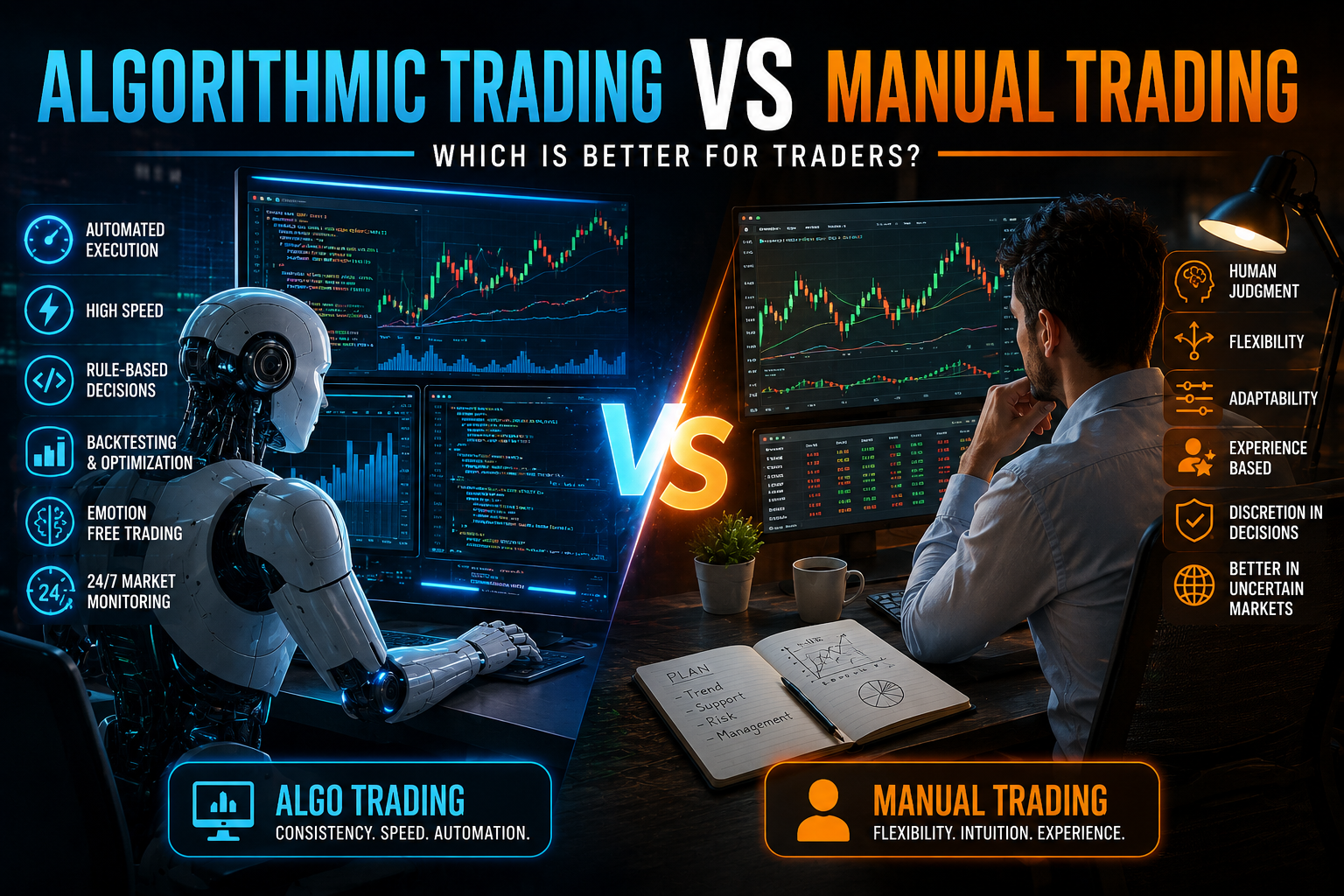
Trading can be approached in many different ways, but two of the most common approaches are manual trading and algorithmic trading.
In manual trading, a trader personally analyzes the market, makes decisions, and places orders. In algorithmic trading, computer software follows predefined rules to analyze market conditions and can generate or execute trades automatically.
So, which is better: algorithmic trading or manual trading?
There is no universal answer. The better approach depends on the trader's strategy, experience, objectives, risk tolerance, technical knowledge, and the markets being traded.
This guide compares algorithmic and manual trading across the factors that matter most.
What Is Manual Trading?
Manual trading is the traditional approach where a person is directly responsible for analyzing the market and executing trades.
A manual trader may use:
- Price charts
- Technical indicators
- Fundamental analysis
- News and economic events
- Support and resistance
- Market patterns
- Trading volume
- Personal experience
For example, a trader may notice that a stock has broken above a resistance level and decide to buy it manually through a trading platform.
The trader then monitors the position and decides when to exit.
Typical manual trading process
Market Analysis → Trading Decision → Order Placement → Position Monitoring → Exit Decision
The human remains involved throughout the process.
What Is Algorithmic Trading?
Algorithmic trading uses computer software to execute predefined trading rules.
An algorithm can monitor market data and evaluate conditions such as:
- Price
- Volume
- Technical indicators
- Volatility
- Time
- Market trends
- Position size
- Risk limits
When the programmed conditions are satisfied, the system can generate a signal or send an order through a broker or exchange API.
For example:
Buy when the 20-period moving average crosses above the 50-period moving average and exit when the opposite crossover occurs.
Instead of manually watching the chart, software can monitor the condition continuously.
Typical algorithmic trading process
Market Data → Strategy → Signal → Risk Management → Order Execution → Monitoring
For a broader introduction, see our guide to What Is Algorithmic Trading? A Complete Guide to Automated Trading.
Algorithmic Trading vs Manual Trading: Key Differences
FactorManual TradingAlgorithmic TradingDecision-makingHumanPredefined software rulesExecutionManually placedCan be automatedSpeedLimited by human reactionCan react very quicklyEmotional influenceHigher potentialCan reduce emotional interventionBacktestingMore difficultBuilt for systematic testingMonitoringRequires human attentionCan monitor automaticallyFlexibilityVery highDepends on programmed rulesScalabilityLimitedCan monitor multiple marketsTechnical knowledgeGenerally lowerUsually higherMaintenanceTrader manages decisionsSystem requires monitoringExecution consistencyCan varyRules can be applied consistently
1. Speed of Execution
One of the biggest differences between manual and algorithmic trading is execution speed.
A manual trader must:
- Observe the market.
- Recognize a setup.
- Decide what to do.
- Open the trading platform.
- Place the order.
An algorithm can evaluate predefined conditions automatically and send an order when those conditions are met.
This can be particularly useful for strategies that depend on precise timing.
However, faster execution does not automatically mean better trading performance.
A fast system executing a poorly designed strategy can lose money faster.
2. Emotional Decision-Making
Human emotions can influence trading decisions.
Common emotional challenges include:
- Fear
- Greed
- FOMO
- Revenge trading
- Hesitation
- Overconfidence
- Panic selling
For example, a trader may have a predefined stop-loss but decide not to close the position because they believe the market will recover.
An algorithm can follow its programmed rules without experiencing fear or greed.
If the system is programmed to exit at a particular condition, it can execute that rule regardless of the trader's emotions.
However, humans are still involved in algorithmic trading because people design strategies, choose parameters, set risk limits, and decide when systems should be modified or stopped.
3. Strategy Consistency
Manual traders can unintentionally change their decisions from one trade to another.
For example:
“I normally enter at this level, but this time the setup looks slightly different.”
This flexibility can sometimes be useful, but it can also create inconsistency.
An algorithm can apply the same predefined rules repeatedly.
If the strategy says:
- Enter at condition A
- Risk 1% of capital
- Exit at condition B
the system can follow those rules consistently.
This makes algorithmic trading particularly useful for strategies that can be expressed clearly using objective rules.
4. Backtesting
Backtesting is one of the strongest advantages of algorithmic trading.
A trader can take a defined strategy and test how it would have behaved using historical market data.
For example:
Strategy:
- Buy after a moving-average crossover.
- Use a predefined stop-loss.
- Exit after an opposite crossover.
A backtesting system can evaluate the strategy over years of historical data.
It can calculate metrics such as:
- Number of trades
- Win rate
- Profit factor
- Maximum drawdown
- Average trade
- Historical return
- Exposure
Manual trading strategies can also be analyzed using historical charts, but systematic automated backtesting makes the process much easier to repeat and measure.
Important limitation
Backtesting does not guarantee future profitability.
Real trading can differ because of:
- Slippage
- Brokerage costs
- Spreads
- Liquidity
- Latency
- Market regime changes
- Execution differences
A strategy that performs well historically still needs proper validation.
5. Market Monitoring
A human trader has limited attention.
Monitoring multiple markets simultaneously can become difficult.
An algorithm can potentially monitor numerous instruments and predefined conditions simultaneously, depending on the system and infrastructure.
For example, a system could monitor:
- Multiple stocks
- Currency pairs
- Futures contracts
- Indices
- Other supported instruments
The software can continuously check whether predefined conditions have been met.
This doesn't mean every market should be traded simultaneously. More opportunities can also mean more risk and complexity.
6. Flexibility
This is an area where manual trading can have an advantage.
A human trader can interpret information that may be difficult to convert into simple rules.
For example, a trader may consider:
- Breaking news
- Management commentary
- Unusual market behavior
- Broader economic conditions
- Unexpected events
An algorithm only knows what it has been programmed or configured to evaluate.
If market conditions change significantly, a strategy may need to be modified or temporarily disabled.
Therefore, algorithmic trading requires careful strategy design and monitoring.
7. Risk Management
Risk management is important in both manual and algorithmic trading.
A manual trader may use:
- Stop-loss orders
- Position sizing
- Maximum daily loss limits
- Portfolio diversification
- Exposure limits
An algorithm can incorporate many of these controls directly into its execution logic.
For example:
If the system reaches a predefined risk limit, it can stop opening new positions.
Automating risk rules can reduce the possibility of accidentally ignoring them during emotionally difficult market conditions.
However, automated risk management must be designed correctly. A programming error can create risk instead of reducing it.
8. Trading Costs
The cost of trading can vary significantly depending on the strategy.
Costs may include:
- Brokerage commissions
- Bid-ask spreads
- Exchange fees
- Data fees
- Slippage
- Technology infrastructure
- Hosting
- API services
Algorithmic systems may trade more frequently than many manual traders.
For high-frequency strategies, even small transaction costs can have a significant impact on performance.
Therefore, realistic testing should include estimated trading costs wherever possible.
9. Technical Requirements
Manual trading generally requires a trading platform, market data, and a reliable internet connection.
Algorithmic trading can require additional infrastructure.
Depending on the system, this may include:
- Programming
- Broker APIs
- Servers or VPS infrastructure
- Databases
- Market-data feeds
- Logging systems
- Monitoring
- Error handling
- Security controls
This creates additional complexity.
An algorithm can automate trading decisions, but it is still software and can experience:
- API failures
- Network problems
- Server outages
- Bugs
- Authentication issues
- Data problems
Therefore, technical reliability is an important part of algorithmic trading.
10. Scalability
Suppose a manual trader wants to monitor 100 instruments.
That can become difficult.
A software system can potentially evaluate large numbers of instruments automatically, depending on the available data and infrastructure.
This makes algorithmic systems more scalable for strategies that have clearly defined rules.
However, scalability should not be confused with profitability.
Trading more instruments or executing more trades does not automatically improve results.
Can Algorithmic Trading Replace Manual Trading?
Not necessarily.
Many traders use a hybrid approach.
For example:
- The trader researches a strategy manually.
- The rules are converted into software.
- The algorithm backtests the strategy.
- The trader reviews the results.
- The system executes predefined trades.
- The trader monitors performance and risk.
This approach combines human judgment with software automation.
The human focuses on research, strategy development, and oversight, while software handles repetitive tasks.
Algorithmic Trading vs Manual Trading: Which Is Better for Beginners?
For someone completely new to trading, learning manual trading concepts can provide a useful foundation.
Before automating a strategy, beginners should understand:
- How markets work
- Orders
- Position sizing
- Stop-losses
- Risk/reward
- Volatility
- Drawdown
- Trading costs
- Leverage
- Market liquidity
Once these concepts are understood, algorithmic trading can be introduced gradually.
A beginner does not necessarily need to build a complex automated system immediately.
A better approach is:
Learn → Build a simple strategy → Backtest → Validate → Paper trade → Monitor → Consider controlled live deployment
When Does Algorithmic Trading Make More Sense?
Algorithmic trading may be particularly useful when:
- Trading rules can be clearly defined.
- The strategy requires continuous monitoring.
- The trader wants systematic backtesting.
- Emotional execution is a recurring problem.
- Multiple instruments need monitoring.
- Trade execution needs to be consistent.
- The strategy generates repetitive decisions.
When Does Manual Trading Make More Sense?
Manual trading may be preferable when:
- Decisions depend heavily on qualitative information.
- The strategy requires significant human interpretation.
- Trading frequency is low.
- The trader wants maximum flexibility.
- The trader is still learning market fundamentals.
- The strategy is difficult to express using objective rules.
The Best Approach May Be a Combination
The debate between manual and algorithmic trading does not always need to be an either-or decision.
A trader can combine both approaches.
For example:
Human
- Research market conditions
- Develop strategy concepts
- Define risk parameters
- Review performance
Algorithm
- Monitor markets
- Calculate indicators
- Generate signals
- Apply predefined risk rules
- Execute orders
- Record trading activity
This creates a system where humans provide strategic oversight while software handles repetitive processes.
How A One Algo Fits Into Algorithmic Trading
At A One Algo, algorithmic trading can be approached as a structured technology and strategy-development process.
A typical workflow can include:
Strategy Research → Development → Backtesting → Risk Analysis → Validation → Deployment → Monitoring
The goal is not simply to automate trades.
The goal is to create a process where trading rules can be defined, tested, measured, and monitored.
Automation can improve consistency and execution, but it does not remove market risk.
Every strategy should be evaluated based on realistic assumptions and appropriate risk controls.
Frequently Asked Questions
Is algorithmic trading better than manual trading?
Neither approach is universally better. Algorithmic trading can provide consistency, automation, speed, and systematic backtesting, while manual trading provides flexibility and human judgment.
Is algo trading more profitable than manual trading?
Not necessarily. Profitability depends on the underlying strategy, risk management, execution, costs, and market conditions. Automation itself does not guarantee profits.
Can algorithmic trading eliminate emotions?
It can reduce emotional involvement during trade execution, but humans still make important decisions about strategy design, capital allocation, parameters, and risk.
Is algorithmic trading suitable for beginners?
Beginners can learn algorithmic trading, but they should first understand trading fundamentals, risk management, and the limitations of backtesting before using real money.
Does algorithmic trading require coding?
Not every platform requires users to write code, but programming knowledge is useful for developing customized strategies and understanding automated trading systems.
Can manual traders use algorithms?
Yes. A trader can use algorithms for specific tasks while retaining manual control over strategy decisions and overall portfolio management.
Can an algorithm trade without human intervention?
Technically, an automated system can execute predefined rules without manual intervention. However, responsible deployment generally requires monitoring, risk controls, maintenance, and human oversight.
What is the biggest advantage of algorithmic trading?
One of the biggest advantages is the ability to execute clearly defined rules consistently while continuously monitoring market conditions.
Final Verdict: Algorithmic Trading or Manual Trading?
Algorithmic trading is not a replacement for good trading strategy. It is a tool for implementing a strategy more systematically.
Manual trading offers flexibility and human judgment. Algorithmic trading offers automation, consistency, speed, systematic testing, and scalability.
For many modern traders, the strongest approach may be combining both.
The important question is therefore not simply:
“Should I trade manually or use an algorithm?”
A better question is:
“Which parts of my trading process can benefit from automation while maintaining appropriate human oversight and risk management?”
When a strategy has clearly defined rules, algorithmic trading can turn those rules into a repeatable process that can be tested, monitored, and improved.
Disclaimer: This article is for educational and informational purposes only and does not constitute financial, investment, or trading advice. Trading involves risk, including the potential loss of capital. Past performance and backtested results do not guarantee future results.