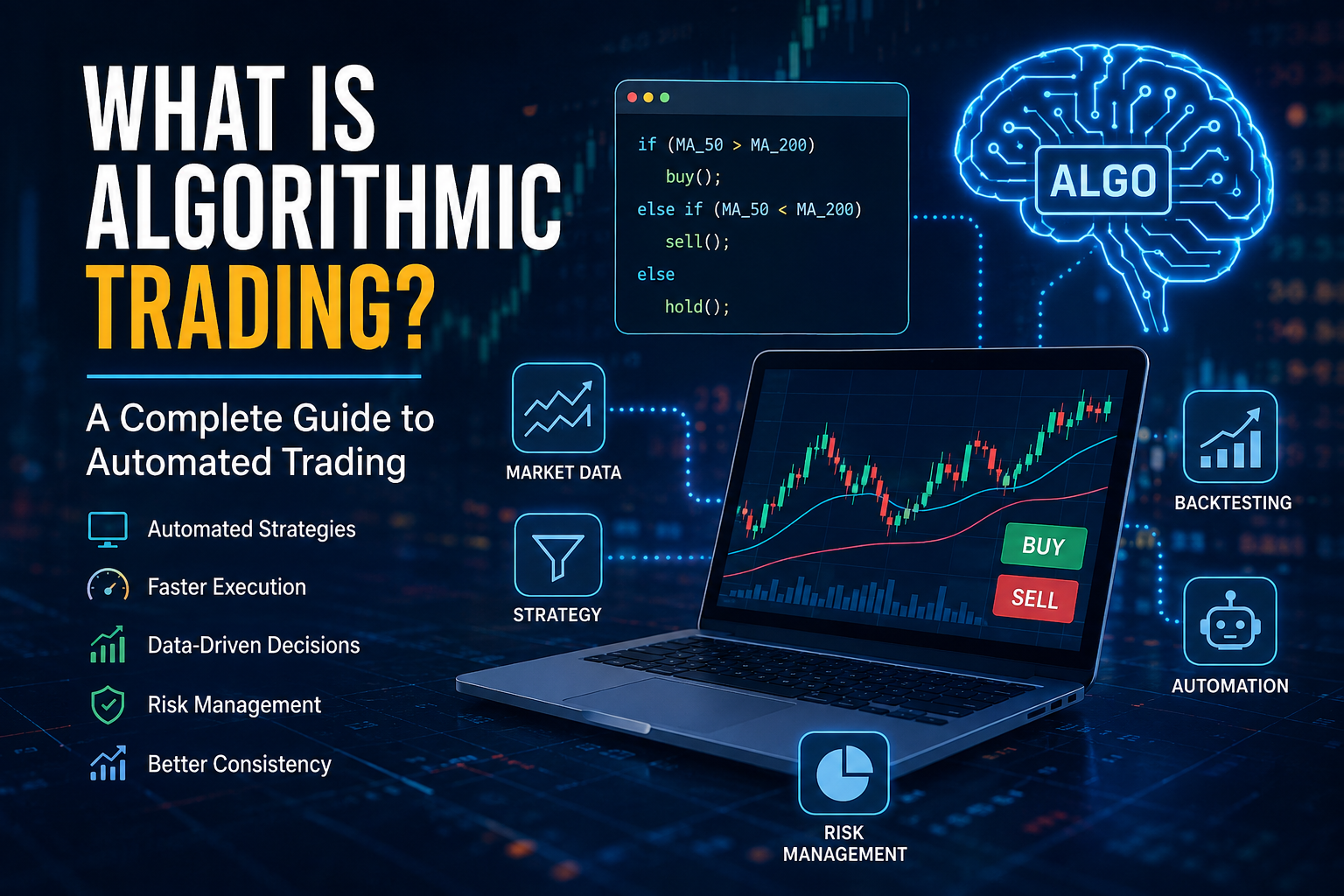
Algorithmic trading is a method of executing trades using computer programs that follow predefined rules. Instead of manually watching charts and deciding when to buy or sell, traders can use algorithms to analyze market data, identify trading opportunities, and execute orders automatically.
Today, algorithmic trading is used across stocks, forex, futures, commodities, cryptocurrencies, and other financial markets. It can help traders execute strategies consistently, reduce emotional decision-making, and process market information much faster than manual trading.
But algorithmic trading is not a guaranteed way to make money. A poorly designed strategy can lose money just as quickly as it can execute profitable trades. Understanding how algorithms work, how strategies are tested, and how risk is managed is therefore essential.
What Is Algorithmic Trading?
Algorithmic trading, often called algo trading, is the use of computer programs to execute trading decisions according to predefined rules.
An algorithm may evaluate conditions such as:
- Price movements
- Trading volume
- Technical indicators
- Market volatility
- Time
- Order-book information
- Risk limits
- Position size
- Market trends
When the programmed conditions are satisfied, the system can generate a trading signal or automatically place an order through a broker or exchange API.
For example, a simple algorithm could be designed around a moving-average crossover:
Buy when the short-term moving average crosses above the long-term moving average, and sell when it crosses below it.
The computer can monitor this condition continuously without requiring the trader to watch the market manually.
How Does Algorithmic Trading Work?
A typical algorithmic trading system consists of several connected components.
1. Market Data
The system first receives market information from a broker, exchange, or data provider.
Depending on the strategy, this could include:
- Live prices
- Historical prices
- Candlestick data
- Volume
- Bid and ask prices
- Market depth
- Trading status
The quality and speed of market data can have a significant impact on an automated strategy.
2. Trading Strategy
The strategy defines the conditions under which the system should take action.
For example:
- Enter when price breaks above resistance.
- Exit when a predefined stop-loss is reached.
- Avoid trading during certain market conditions.
- Reduce position size when volatility increases.
These rules are converted into software that can evaluate them consistently.
3. Signal Generation
The algorithm processes the incoming data and determines whether the conditions for an entry or exit have been satisfied.
A signal could be:
BUY
SELL
EXIT
or
NO ACTION
4. Risk Management
A professional trading system should not focus only on finding entries.
It should also define:
- Maximum position size
- Stop-loss rules
- Maximum daily loss
- Maximum number of open positions
- Capital allocation
- Exposure limits
- Trade frequency
Risk management can be built directly into the algorithm so that the system does not exceed predefined limits.
5. Order Execution
If the strategy generates a valid trading signal, the system can send the order to a broker or exchange through an API.
The broker then processes the order according to its available liquidity, execution rules, and market conditions.
6. Monitoring and Logging
A reliable algorithmic trading system should record important events, including:
- Signals generated
- Orders submitted
- Orders filled
- Orders rejected
- Entry and exit prices
- Errors
- API responses
- Position status
These logs help developers and traders understand how the system behaved.
Algorithmic Trading vs Manual Trading
The biggest difference between manual and algorithmic trading is how decisions and execution are handled.
Manual TradingAlgorithmic TradingTrader monitors the marketSoftware monitors market conditionsDecisions are made manuallyDecisions follow programmed rulesHuman emotions can influence tradesRules can reduce emotional interventionExecution depends on the traderOrders can be executed automaticallyDifficult to monitor many markets simultaneouslySoftware can monitor multiple instrumentsStrategy execution can varyRules can be applied consistently
Algorithmic trading does not necessarily replace human decision-making. Many traders use a hybrid approach where humans design, test, monitor, and modify strategies while software handles repetitive execution.
What Are the Benefits of Algorithmic Trading?
Consistent Execution
Once a strategy has been programmed, the same rules can be applied repeatedly.
This can help reduce inconsistent decisions caused by fear, greed, hesitation, or overconfidence.
Speed
Computers can analyze data and submit orders much faster than a human trader can manually react.
However, speed alone does not create a profitable strategy. The quality of the underlying strategy and execution infrastructure remains critical.
Continuous Monitoring
An algorithm can monitor predefined conditions without requiring a trader to sit in front of a chart throughout the trading session.
Backtesting
One of the major advantages of algorithmic trading is the ability to test a strategy against historical data before deploying it in live markets.
Backtesting can help answer questions such as:
- How did the strategy perform historically?
- How large was its maximum drawdown?
- How frequently did it trade?
- What happened during different market conditions?
Historical performance, however, does not guarantee future results.
Reduced Emotional Intervention
Automated rules can reduce the influence of emotions during execution.
A system can follow its predefined entry, exit, and risk rules even when market conditions become stressful.
What Is Backtesting?
Backtesting is the process of evaluating a trading strategy using historical market data.
Suppose an algorithm uses the following simplified rules:
- Buy when the 20-day moving average crosses above the 50-day moving average.
- Risk a fixed percentage of capital on each trade.
- Exit when the opposite crossover occurs.
A backtesting engine can apply these rules to historical data and calculate hypothetical results.
Common backtesting metrics include:
- Total return
- Number of trades
- Win rate
- Average profit and loss
- Maximum drawdown
- Profit factor
- Risk-adjusted performance
- Exposure
Backtesting is useful, but it has limitations.
Historical data may not perfectly represent live execution. Slippage, commissions, spreads, liquidity, latency, rejected orders, and changing market conditions can all affect real-world results.
What Is Forward Testing?
After historical testing, traders may use forward testing or paper trading to evaluate a strategy under current market conditions without necessarily risking real capital.
This can help identify differences between theoretical backtest results and real-time behavior.
A typical development process can look like:
Strategy idea → Backtesting → Optimization → Out-of-sample testing → Paper trading → Controlled live deployment → Monitoring
What Is Overfitting in Algorithmic Trading?
One of the biggest risks in strategy development is overfitting.
Overfitting occurs when a strategy is excessively optimized for historical data and performs well on that specific dataset but fails to generalize to new market conditions.
For example, a developer might repeatedly adjust dozens of parameters until a strategy produces excellent historical results.
That does not necessarily mean the strategy is robust.
A more reliable development process uses techniques such as:
- Out-of-sample testing
- Walk-forward analysis
- Multiple market periods
- Different instruments where appropriate
- Conservative assumptions
- Realistic transaction costs
The objective is not to create the best-looking historical backtest. The objective is to develop a strategy that has a reasonable chance of behaving consistently under conditions it has not seen before.
What Is Slippage?
Slippage is the difference between the expected execution price and the actual execution price.
For example, an algorithm may attempt to buy at $100, but the order may be filled at $100.05 because the market moved before execution.
Slippage can become particularly important for strategies that:
- Trade frequently
- Use market orders
- Operate during volatile periods
- Trade instruments with limited liquidity
Therefore, realistic backtesting should account for expected transaction costs and execution effects whenever possible.
What Is API Trading?
An API, or Application Programming Interface, allows software to communicate with another system.
In algorithmic trading, a broker or exchange may provide an API that allows an application to:
- Retrieve market data
- Check account information
- Submit orders
- Modify orders
- Cancel orders
- Monitor positions
- Retrieve trade history
A simplified architecture might look like this:
Market Data → Algo Engine → Strategy Rules → Risk Management → Broker API → Order Execution
The system can then receive execution information from the broker and update its internal state.
Is Algorithmic Trading Profitable?
Algorithmic trading can be profitable, but there is no guarantee of profit.
An algorithm is simply a method of automating trading rules. Automation does not automatically make those rules profitable.
A strategy's performance can be affected by:
- Market conditions
- Strategy design
- Risk management
- Transaction costs
- Slippage
- Liquidity
- Execution quality
- Technology failures
- Parameter selection
- Changes in market behavior
A strategy that worked historically can also stop working as market conditions change.
For this reason, algorithmic trading should be approached as a process of research, testing, risk management, execution, and continuous monitoring—not as a guaranteed source of returns.
Is Algo Trading Suitable for Beginners?
Beginners can learn algorithmic trading, but they should understand the fundamentals before deploying real capital.
A sensible learning path is:
- Learn basic financial-market concepts.
- Understand technical and quantitative strategies.
- Learn programming fundamentals.
- Study risk management.
- Learn how APIs and order execution work.
- Build a simple strategy.
- Backtest it.
- Test it on unseen data.
- Paper trade it.
- Monitor live performance carefully before considering larger capital.
Beginners should also understand that automated trading can introduce technical risks that do not exist in the same way with manual trading.
Common Mistakes in Algorithmic Trading
Ignoring Transaction Costs
A strategy can appear profitable before commissions, spreads, and slippage but become unprofitable after realistic costs are included.
Optimizing Too Much
Excessive optimization can create an overfit strategy.
Using Unrealistic Backtests
Assuming perfect execution and unlimited liquidity can make historical results look better than what might be achievable in live markets.
Ignoring Risk Management
A high-return backtest is not enough. Maximum drawdown and potential losses should be considered carefully.
Deploying Directly to Live Markets
A new strategy should generally be tested thoroughly before live deployment.
Failing to Monitor the System
Automated systems still require monitoring. APIs can fail, servers can experience outages, market conditions can change, and software can contain bugs.
How A One Algo Approaches Algorithmic Trading
At A One Algo, algorithmic trading should be viewed as a technology-driven process rather than simply an automated buy-and-sell system.
A robust workflow can include:
Research → Strategy Development → Backtesting → Risk Analysis → Validation → Deployment → Monitoring
The focus should be on building systems with clearly defined rules, measurable assumptions, appropriate risk controls, and transparent performance evaluation.
Automation can make execution more systematic, but the underlying strategy still needs to be researched and validated.
Frequently Asked Questions
What is algorithmic trading in simple words?
Algorithmic trading is using computer software to follow predefined trading rules and, when appropriate, automatically generate or execute trades.
Is algorithmic trading the same as automated trading?
The terms are often used interchangeably. Algorithmic trading generally refers to using programmed rules to make trading decisions or execute orders, while automated trading is a broader term for systems that automate part or all of the trading process.
Do I need programming knowledge for algo trading?
Not necessarily for every platform or strategy, but programming knowledge is highly valuable when developing, testing, customizing, and maintaining algorithmic trading systems.
Can algo trading eliminate losses?
No. Algorithmic trading cannot eliminate market risk. An automated strategy can lose money, and technical or execution problems can create additional risks.
How is an algorithmic trading strategy tested?
A strategy can be tested using historical data through backtesting, followed by methods such as out-of-sample testing, walk-forward analysis, and paper trading.
Is backtested performance guaranteed in live trading?
No. Historical or simulated performance does not guarantee future results. Live trading can differ because of market conditions, liquidity, transaction costs, slippage, latency, and other factors.
What markets can support algorithmic trading?
Depending on the broker, exchange, technology, and strategy, algorithmic trading can be used in markets such as equities, forex, futures, commodities, and cryptocurrencies.
Final Thoughts
Algorithmic trading combines financial-market strategies with software and automation. Instead of relying entirely on manual execution, traders can create systems that analyze predefined conditions, manage rules, and interact with brokers or exchanges programmatically.
The biggest advantage of algorithmic trading is not simply speed. It is the ability to create a repeatable, testable, and measurable trading process.
At the same time, automation does not remove risk. Successful algorithmic trading requires careful strategy research, realistic testing, disciplined risk management, reliable technology, and continuous monitoring.
For anyone considering algo trading, the best starting point is not searching for a strategy that promises guaranteed returns. It is learning how strategies are designed, tested, evaluated, and responsibly deployed.
Disclaimer: This article is provided for educational and informational purposes only and does not constitute financial, investment, or trading advice. Trading financial markets involves risk, including the possible loss of capital. Past performance and backtested results do not guarantee future results.